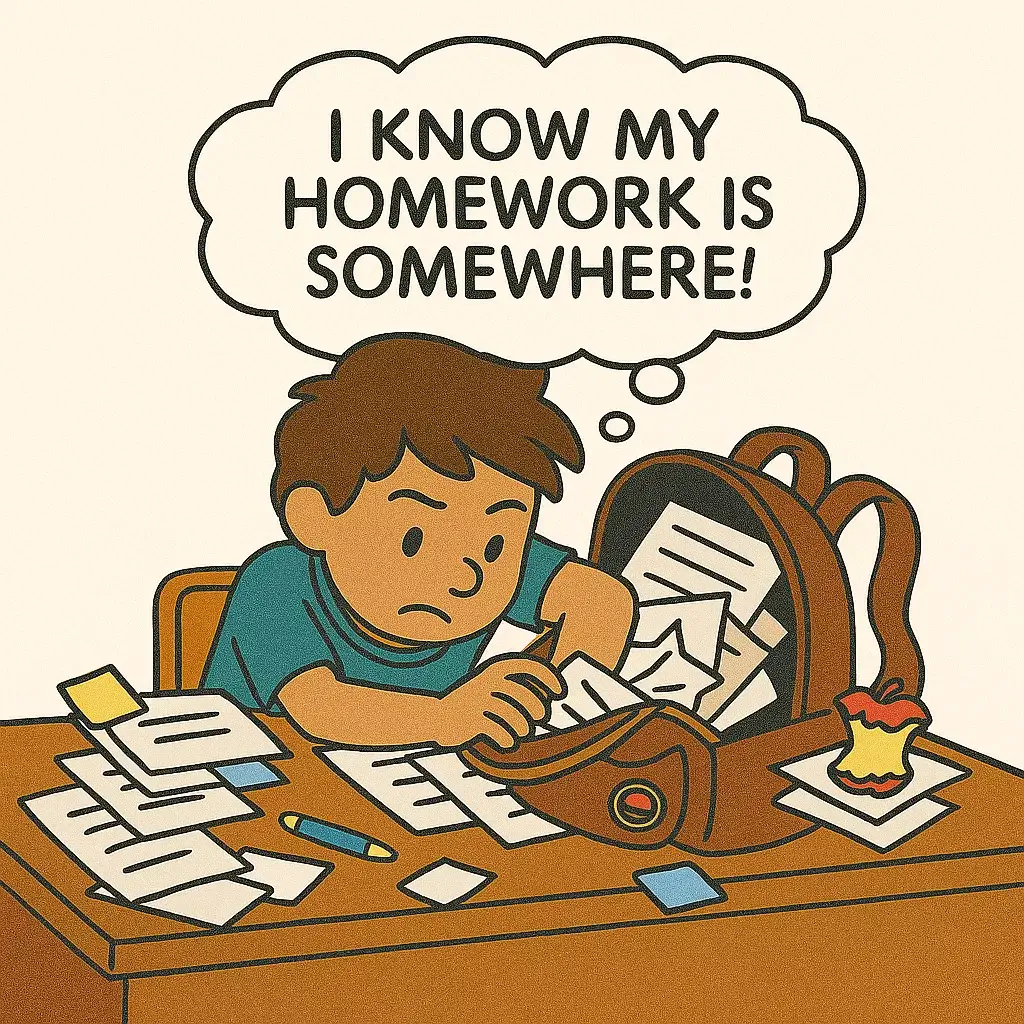
Ever watch your kid freeze at the kitchen table, paralyzed by a homework assignment that’s due tomorrow… while their soccer cleats are still missing and their sibling is asking for help with a video game?
Welcome to their mental control tower—aka, executive functioning.
When it’s working well, this part of the brain helps kids decide what to focus on, what to ignore, when to pause, and how to shift. It’s like a smart internal assistant managing priorities, emotions, and actions behind the scenes —helping kids stay on task and complete tasks with better time management and emotion regulation.
When it’s underdeveloped—or overwhelmed—everything comes in for landing at once: worries, distractions, impulsive ideas, forgotten tasks. That’s when we see meltdowns, avoidance, or chaos in motion.
The good news? These skills aren’t fixed. They can be nurtured, practiced, and strengthened—just like muscles.
In this guide, we’ll unpack what executive functioning really means, why it’s become a hot topic in schools and homes, and how you can help the kids you care about build these life-changing skills.
Table of Contents
- What Does Executive Functioning Mean?
- What Are the Skills in Executive Functioning?
- Executive Functioning and the Brain
- Why Is Executive Functioning So Trendy Right Now?
- Why Do These Skills Matter?
- Can We Teach These Skills?
- How do We Recognize Executive Functioning Struggles?
- How Do You Build Executive Functioning Skills?
- Want to Help Kids Build These Skills?
1. What Are Executive Functioning Skills?
What are executive functioning skills? They’re a set of mental processes—or executive functions—that help us regulate behavior, make decisions, and adapt to challenges. They involve the ability to plan, organize, stay on task, pay attention, and shift when needed.
Researchers and psychologists define executive functioning in slightly different ways:
- “The mental processes that enable us to plan, focus attention, remember instructions, and juggle multiple tasks successfully.”— Harvard Center on the Developing Child
- “Self-directed actions needed to choose goals and to create, enact, and sustain actions toward those goals.”— Dr. Russell Barkley, ADHD expert
- “The brain-based skills required for humans to execute or perform tasks.”— Peg Dawson & Richard Guare, authors of Smart but Scattered
- “A set of processes that all have to do with managing oneself and one’s resources in order to achieve a goal…”— Gioia, Isquith, Guy, & Kenworthy (2000)
At GoZen, we like to keep it simple: Executive Functioning Skills allow us to set a goal and then work backwards to achieve that goal. That’s why we often say: Executive Functioning Skills help us GSD—or Get Stuff Done.
Coaching phrase: “Let’s figure out the goal first, then we can map out a path to get there.”
2. What Are the Skills in Executive Functioning?
So, what are executive functioning skills really about? Executive functioning sounds complex, but at its core, it’s about the everyday tools kids use to get stuff done—at home, in school, and in their relationships. These are the mental habits and abilities that allow us to start a task, stay with it, switch gears when needed, and keep emotions in check along the way. Even simple tasks—like packing a backpack or following classroom directions—can feel overwhelming without strong executive functioning.
At GoZen, we use our unique GROWTH PLANS™ framework to teach 11 core executive functioning skills. Grab this free printable here.
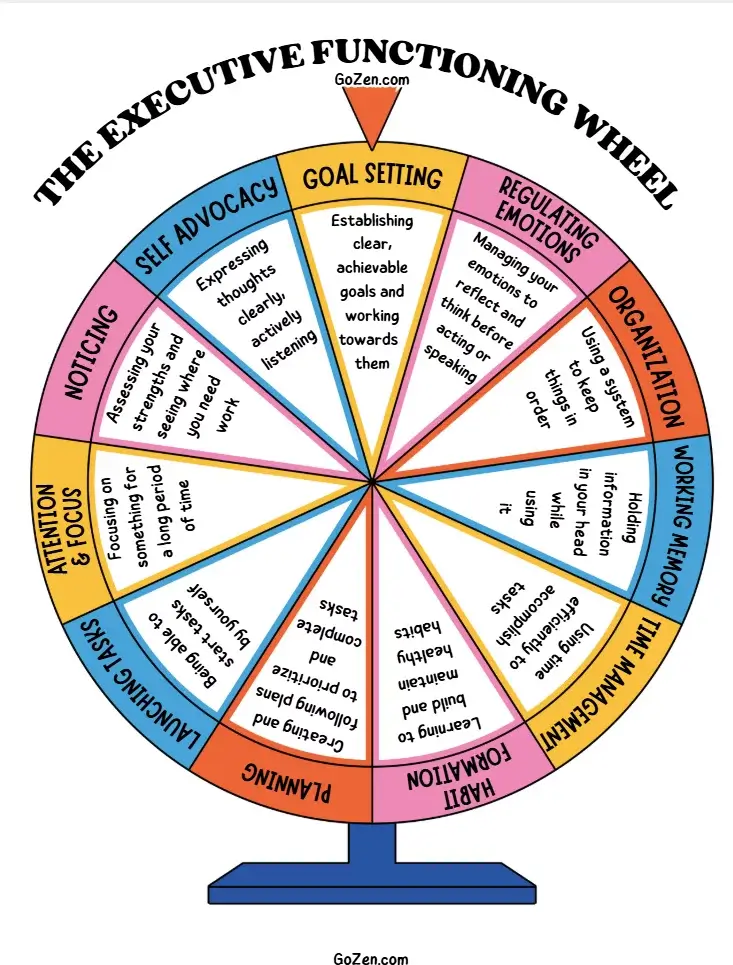
- Goal Setting
- Regulation
- Organization
- Working Memory
- Time Management
- Habit Formation
- Planning
- Launching Tasks
- Attention & Focus
- Noticing
- Self-Talk
These aren’t standalone skills—they work together. For example, time management relies on noticing how long things take and talking yourself through tasks. These executive function skills work together to help kids plan, organize, complete tasks, and manage their emotions.
3. Executive Functioning and the Brain
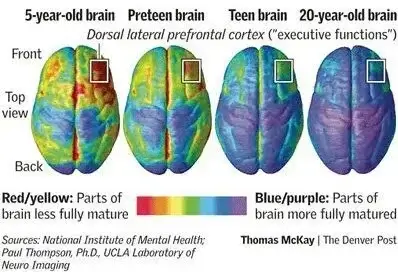
Executive functioning lives in the prefrontal cortex—the area just behind your forehead. Think of it as the CEO of the brain, or the air traffic controller. It’s in charge of prioritizing information, deciding what actions to take, and regulating emotional and behavioral responses.
This area is incredibly powerful, but it takes time to develop. Executive functions develop gradually and continue to mature into adulthood. The prefrontal cortex is one of the last brain regions to fully mature, often continuing into the mid-to-late 20s. That’s why a 12-year-old might know they need to finish homework or stop interrupting—but still struggle to follow through. It’s not a failure of willpower; it’s a reflection of ongoing brain development.
Why This Matters for Kids
- Kids are often expected to act like mini-adults, but their brains are still under construction.
- Stress, trauma, sleep deprivation, or screens can all affect developing executive skills.
- For neurodivergent kids, including those with ADHD or autism, executive functioning issues are often more pronounced.
A study from the National Institute of Mental Health found that children with ADHD can have a 30% developmental delay in EF-related brain areas. That means a 10-year-old may function more like a 7-year-old when it comes to planning, focusing, or regulating emotions.
Instead of asking, “Why can’t they just do it?” try asking, “What’s the underlying skill they’re still developing?”
Coaching phrase: “Your brain is still growing this skill. Let’s practice it together.”
4. Why Is Executive Functioning So Trendy Right Now?
If it feels like everyone is suddenly talking about executive functioning, you’re not wrong. Once tucked away in neuroscience journals, executive functioning is now a central focus in parenting books, school staff meetings, therapy offices, and coaching trainings.
Why the shift?
-> Kids are facing more demands than ever
Today’s kids balance school, sports, family responsibilities, and digital life— kids need strong executive function skills to balance their busy lives.. They’re expected to manage complex schedules, switch tasks quickly, and stay emotionally regulated—all while dealing with a world that moves fast and rewards speed.
-> The pandemic exposed skill gaps
When routines vanished and learning went virtual, many kids (and adults) struggled. Teachers noticed students weren’t just behind in math—they were behind in planning, organizing, and managing stress. Executive functioning became the missing link.
-> Mindset shifts in parenting and education
We’re moving away from “fix the behavior” to “build the skill.” Parents and educators realize that behavior issues often signal lagging executive functioning skills—not laziness or defiance.
-> More research is connecting executive functioning to long-term outcomes
Developmental psychologists have found that executive function skills are more predictive of school readiness than IQ. Kids don’t need to be geniuses—they need the mental tools to manage themselves and their responsibilities.
Teacher insight: “It’s not that students don’t know the material—it’s that they can’t find it, focus on it, or finish it.”
Executive functioning is no longer a nice-to-have. It’s a core life skillset—just as important as literacy or numeracy.
5. Why Do Executive Functioning Skills Matter?
Let’s paint two pictures:
-> Meet Jordan—a 5th grader with sharp executive functioning skills. Jordan uses a checklist in the morning, packs their backpack the night before, and knows when to ask for help. They bounce back after a mistake and stay (mostly) on track even when things don’t go as planned.
-> Now meet Avery, the same age, but struggling with executive functioning. Mornings are chaotic, assignments get left at home, emotions spill over easily, and simple tasks feel impossible to start. Avery’s capable—but stuck.
This is the power of executive functioning. It shapes how kids show up in their lives.
Academic Success
Kids with strong executive functioning skills can better complete a task, use time wisely, and manage short-term memory. One study found they score 25% higher on standardized tests.
Coaching phrase: “Let’s break this down into steps. You don’t have to do it all at once.”
Friendship & Social Skills
Executive functioning skills like impulse control and flexible thinking help kids manage conflict, share, and adapt. Skills like cognitive flexibility and inhibitory control help kids adapt in group settings. Studies show these kids are 30% more likely to maintain strong friendships.
Coaching phrase: “Sounds like you noticed your friend felt left out—that’s awareness in action.”
Future Readiness
Kids with strong executive functioning are better equipped for life: making decisions, managing time, handling stress. A 2025 study in Frontiers in Psychology linked executive functioning in childhood to adult well-being and career success.
Coaching phrase: “These are life muscles. Every time you practice, they get stronger.”
6. Can We Be Successful at Teaching Executive Functioning Skills?
Yes— teaching executive functioning skills works. It’s not about fixing kids. It’s about empowering them with the tools they need.
A 2011 meta-analysis by Diamond & Lee showed that engaging executive functioning programs leads to better academics and social skills. The key is relevance, repetition, and real-life application.
Start with What Matters to Them
If a child wants to beat a game, build a YouTube channel, or hang out with friends, they’ll care about the executive functioning skills that make it possible.
Scaffold, Don’t Fix
Coaching executive functioning means supporting, not swooping in. Kids don’t need fixing—they need tools and trust.
Coaching phrase: “You’ve got the ideas. Let’s build the routines to carry them out.”
7. How Do We Recognize Executive Functioning Issues?
We all have days when we feel disorganized or distracted, but persistent struggles in these areas may signal underdeveloped executive functioning skills. The challenge is that these behaviors often look like something else: defiance, laziness, forgetfulness.
5 Red Flags to Watch For
- Disorganization: Constantly losing materials or turning in incomplete work.
- Time Troubles: Difficulty estimating how long tasks take or chronically running late.
- Impulsivity: Blurting out, interrupting, or making rash decisions.
- Big Emotions: Overreactions to setbacks or transitions.
- Memory Hiccups: Forgetting multi-step instructions or losing track of routines.
These challenges aren’t character flaws—they’re signs that a child may need support, coaching, and practice.
It’s also important to remember: while nearly all kids with ADHD struggle with executive functioning, not all kids with executive functioning struggles have ADHD. Kids with anxiety, trauma, or learning differences may also show signs.
Coaching phrase: “You’re not bad at this—you’re still learning it. Let’s figure out what’s getting in your way.”
8. How Do We Build Executive Functioning Skills?
Executive functioning can—and should—be strengthened in joyful, practical ways. Worksheets have their place, but what really makes skills stick is practice in the flow of real life. Here are some engaging ways to build executive functioning skills at home or in school:
- Time Estimation Games: Ask kids to guess how long a task will take, then time it and compare.
- Beat the Timer Challenges: Turn routines into races—”Can you clean your room in 7 minutes?”
- Visual Checklists: Pictures or color-coded steps make routines easy to follow independently.
- Goal-Setting Challenges: Let kids pick one small goal each week (e.g., remember their water bottle) and celebrate progress.
- Working Memory Workouts: Games like Uno, Simon, or the “grocery list” memory challenge build retention.
Model Your Own Executive Functioning Skills
Executive functioning skills are often caught, not just taught. Let kids hear your inner voice as you work through problems:
“This feels overwhelming, so I’m going to write out the steps.”
“I’m having trouble focusing—time to take a quick movement break.”
“I don’t feel like starting, but I’m going to do the first 5 minutes and see how it goes.”
The key? Keep it low-pressure and connected. Kids are likelier to build habits when they feel safe, seen, and supported—not judged.
Coaching phrase: “Let’s find a strategy that works for you. We’ll test it together.”
9. Want to Help Kids Build These Skills?
Don’t miss our upcoming Executive Functioning Empowerment Summit 2.0 coming this September 2025. We’ve interviewed 35 thought leaders who will teach parents, educators, and mental health professionals cutting-edge techniques to help kids and teens boost executive functioning skills. The best part? It’s free!
Do not miss this incredible (FREE!) virtual summit – join the notification list for the event launch here and get the free GROWTH PLANS printable wheel: