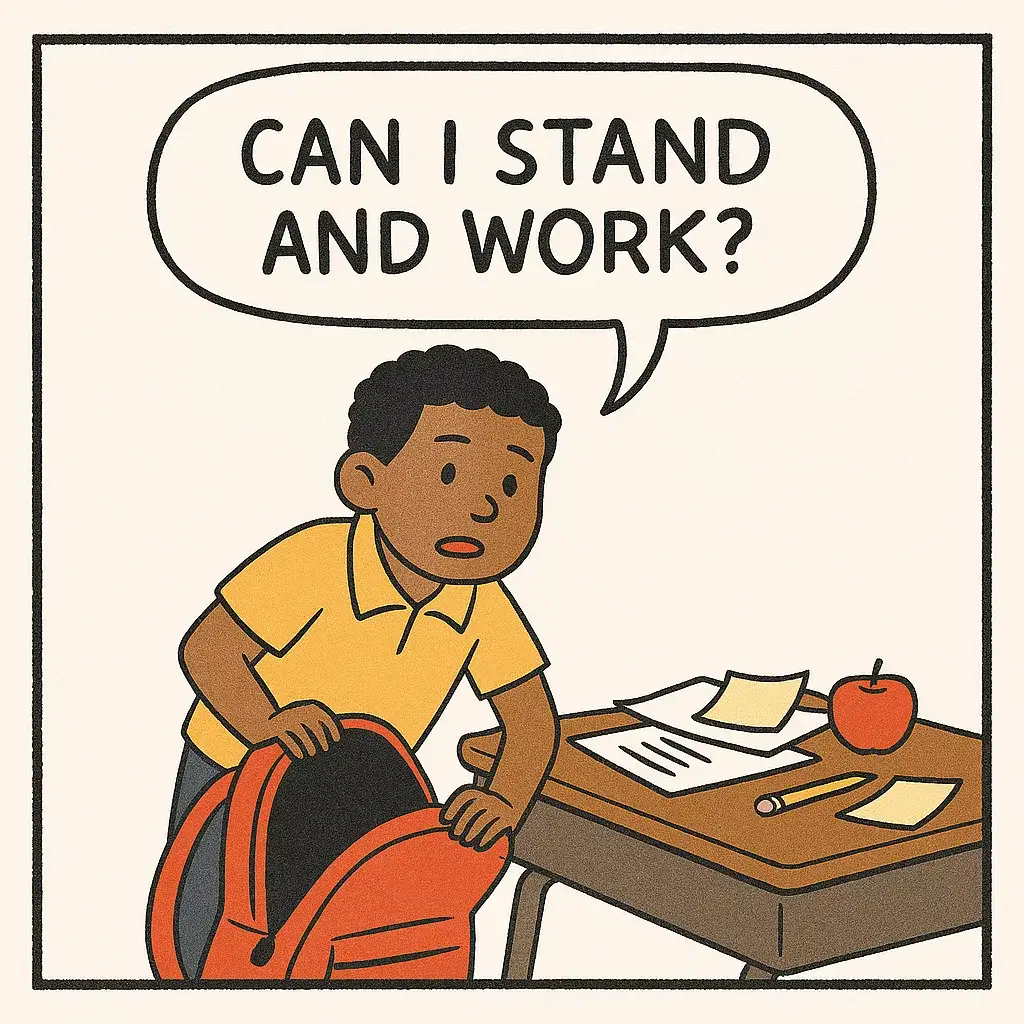
If you’ve ever tried to help a child with ADHD through a school day, you know how exhausting it can be.
A teacher is mid-lesson, scanning the room for understanding, and catches sight of a student staring out the window, lost in a world of their own. Across the hall, another child is bouncing in their seat, blurting out answers before the question is even finished. At home, a parent sits beside their child at the kitchen table, repeating the same math problem directions for the fourth time — and still, the numbers seem to slide right off the page and vanish.
For parents and educators alike, the challenges can feel relentless. Some days, it seems like no matter how many reminders, consequences, or pep talks you give, nothing changes. But here’s what years of research and lived experience tell us: with the right accommodations, kids and teens with ADHD can flourish.
These supports aren’t “special treatment.” They’re adjustments that level the playing field, allowing a child’s real strengths to emerge. They turn school from a battlefield into a place where learning is possible — even joyful. And while no single strategy works for every child, there are proven approaches that, when matched thoughtfully to a student’s needs, make a profound difference.
Table of Contents
- Why ADHD Accommodations Matter
- Creating a Foundation: Principles to Keep in Mind
- The Realities and Challenges of Implementing Accommodations
- Helping Kids Stay Focused in a World Full of Distractions
- Organization & Time Management: Taming the Chaos
- Movement & Sensory Regulation
- Academic Skill Supports
- Testing & Assessment
- Impulsiveness & Self-Control
- Long-term Resilience
- Social Skills & Peer Relationships
- Communication & Home-School Connection
- Grab Your ADHD Accommodation Cheat Sheet
1: Why ADHD Accommodations Matter
ADHD isn’t simply about being “easily distracted” or “too energetic.” It’s a neurological difference that affects attention, impulse control, working memory, and planning. In a typical classroom, where students are expected to sit still, follow multi-step instructions, and manage their own time, these challenges can lead to repeated failures and frustration.
Without accommodations, children with ADHD often face a daily cycle of missed instructions, incomplete work, and negative feedback. Over time, this can erode their confidence, strain relationships with teachers and parents, and even affect their willingness to try.
Accommodations break this cycle. They don’t change the expectations — students are still responsible for mastering the material — but they remove the barriers that ADHD puts in the way. A child who struggles to focus in a busy classroom might excel with a quieter seat and visual reminders. A student who melts down over a long assignment may thrive when it’s broken into smaller, timed chunks.
And when we get it right? The shift is visible — in their body language, in the quality of their work, and in the way they start to believe, “I can do this.”
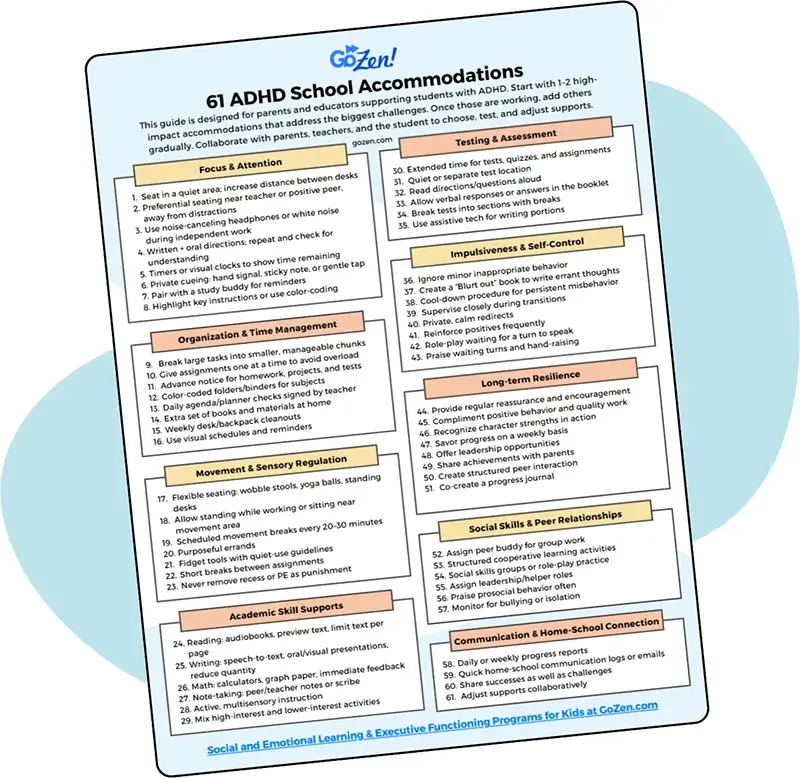
Want all 61 accommodations in one place? Download the ADHD Accommodations Cheat Sheet here.
2: Creating a Foundation: Principles to Keep in Mind
Before diving into specific strategies, it’s worth remembering that effective accommodations share a few common traits:
- They’re individualized. ADHD shows up differently in every child. What works for one student may frustrate another.
- They’re proactive. The best accommodations prevent problems instead of reacting after a meltdown or missed deadline.
- They focus on strengths. Kids with ADHD often have creativity, humor, and unique problem-solving abilities. Good accommodations make space for those strengths to shine.
- They’re a team effort. Parents, teachers, and — whenever possible — the student themselves should be involved in creating and adjusting the plan.
3: The Realities and Challenges of Implementing Accommodations
Accommodations can transform a student’s school experience — but putting them into practice isn’t always easy. Teachers are juggling the needs of 20 or more students, each with their own strengths, struggles, and personalities. Parents are managing homework battles, after-school activities, and sometimes multiple children with different needs. Even when everyone is committed to supporting a student with ADHD, finding the time, energy, and consistency to try every possible strategy can feel overwhelming.
It’s important to remember: you don’t have to implement every accommodation at once. In fact, trying to do too much too quickly can backfire. Instead, start by identifying one or two high-impact accommodations — the ones most likely to create a positive ripple effect on other areas of learning and behavior.
For example:
- If impulsive blurting is derailing lessons and causing social friction, introducing a private cue and immediate positive reinforcement might improve both classroom flow and peer relationships.
- If missing assignments is the main source of stress, focusing on a daily agenda check and giving assignments one at a time could dramatically reduce conflict at home and school.
Once those strategies are working smoothly, you can layer in additional supports. This approach makes it easier for teachers and parents to stay consistent, track what’s effective, and avoid feeling like they’re spinning plates that keep falling.
Helping Classmates Understand Accommodations
One challenge that’s often overlooked is how accommodations are perceived by peers. A neurotypical student might wonder why a classmate gets extra time on a test, can move around during lessons, or doesn’t have to complete the same number of problems. Without context, it can look like “special treatment.”
While it’s essential to respect privacy, there are ways to normalize accommodations so they’re understood as tools — not privileges. For example, teachers might explain that everyone learns differently, and some students use different strategies or tools to help them do their best, just as some might wear glasses or use a calculator. This can build empathy and reduce resentment, helping all students see accommodations as part of an inclusive learning environment.
4: Helping Kids Stay Focused in a World Full of Distractions
For many students with ADHD, focus isn’t about willpower — it’s about environment. A desk near the door can mean dozens of distractions. A long string of oral instructions can disappear before pencil touches paper.
Small changes reduce distractions without isolating the student. Sitting near the teacher or a positive role model helps them stay engaged. Pairing verbal instructions with written or visual ones gives them a reference point. Study carrels during independent work can create a quiet bubble for thinking.
What Works:
- Seat in a quiet area; increase the distance between desks
- Preferential seating near teacher or positive peer, away from distractions
- Use noise-canceling headphones or white noise during independent work
- Written + oral directions; repeat and check for understanding.
- Use timers or visual clocks to signal time remaining.
- Private cueing: hand signal, sticky note, or gentle tap.
- Pair with a study buddy for reminders and modeling.
- Highlight key instructions or use color-coding for emphasis.
5: Organization & Time Management: Taming the Chaos
Ask any parent of a child with ADHD about missing homework, and you’ll hear some version of: “I watched them put it in the folder. By the time it got to school… gone.”
Organizational supports take the guesswork out of getting from point A to point B. Color-coded binders, daily agenda checks signed by a teacher, and an extra set of textbooks at home mean fewer crises. Breaking large projects into smaller steps with interim deadlines keeps the workload manageable and prevents last-minute panic.
What Works:
- Break large tasks into smaller, manageable chunks.
- Give assignments one at a time to avoid overload.
- Advance notice for homework, projects, and tests.
- Color-coded folders/binders for subjects.
- Daily agenda/planner checks signed by teacher.
- Homework assignment book with supervision.
- Extra set of books and materials at home.
- Weekly desk/backpack cleanouts with adult support.
- Organization rules and posted routines.
- Use of checklists for multi-step tasks.
- Visual schedules and reminders in workspace.
6: Movement & Sensory Regulation
Some students need to move to think — it’s not defiance, it’s physiology. Accommodations channel that movement productively: flexible seating like wobble stools or standing desks, scheduled “brain breaks,” or purposeful errands. These outlets help regulate energy and maintain focus.
One thing to avoid? Removing recess. For ADHD students, movement is essential — taking it away often backfires.
What Works:
- Flexible seating: wobble stools, yoga balls, standing desks.
- Allow standing while working or sitting near a movement area.
- Scheduled movement breaks every 20–30 minutes.
- Purposeful errands.
- Fidget tools — with quiet-use guidelines.
- Short breaks between assignments.
- Never remove recess or PE as punishment.
7: Academic Skill Supports
Adjusting instruction to match strengths and needs prevents frustration and builds success. This can mean alternative ways to demonstrate learning or tools that reduce barriers.
What Works:
- Reading: extra time; previewing text; limit text per page; audiobooks; avoid forced oral reading.
- Writing: speech-to-text; accept oral or visual presentations; reduce quantity; grade for content, not neatness.
- Math: calculators; graph paper; model correct procedures; immediate feedback.
- Note-taking: copy of peer or teacher notes; use of a scribe.
- Active participation and multisensory instruction.
- Mix high-interest and lower-interest activities.
8: Testing & Assessment
Tests can feel like a race against both the clock and their own thoughts. Extended time, a quiet location, or having questions read aloud can level the playing field.
What Works:
- Extended time for tests, quizzes, and assignments.
- Quiet or separate test location.
- Read test directions/questions aloud.
- Allow verbal responses or answers in the test booklet.
- Break tests into smaller sections with breaks.
- Use word processors or assistive tech for writing portions.
9: Impulsiveness & Self-Control
Impulsiveness — blurting out, interrupting, acting without thinking — can derail learning for the student and the class. The goal is to reduce these moments without shaming or constant correction.
What Works:
- Ignore minor inappropriate behavior
- Create a “Blurt Out” book to write errant thoughts
- Cool-down procedure for persistent misbehavior
- Supervise closely during transitions
- Private, calm redirects
- Reinforce positives frequently
- Role-play waiting for a turn to speak
- Praise waiting turns and hand-raising
10: Long-term Resilience
Sometimes the hardest part isn’t academics — it’s managing emotions. Meltdowns, anxiety, and frustration can derail the day. Proactive emotional supports build resilience and prevent crises.
What Works:
- Provide regular reassurance and encouragement
- Compliment positive behavior and quality work
- Recognize character strengths in action
- Savor progress on a weekly basis
- Offer leadership opportunities
- Share achievements with parents
- Create structured peer interaction
- Co-create a progress journal
11: Social Skills & Peer Relationships
Strong peer connections help ADHD students feel included and confident. Social accommodations create opportunities for positive interactions.
What Works:
- Assign a peer buddy for group work or transitions.
- Structured cooperative learning activities.
- Social skills groups or small-group role-play practice.
- Assign leadership or helper roles to highlight strengths.
- Praise and acknowledge prosocial behavior often.
- Monitor for bullying or isolation and intervene early.
12: Communication & Home-School Connection
The best plans work when parents and teachers are in sync. Ongoing communication keeps everyone aligned and able to adapt.
What Works:
- Daily or weekly progress reports.
- Quick home-school communication logs or emails.
- Share successes, not just challenges.
- Adjust accommodations collaboratively when needed.
13: Grab Your ADHD Accommodation Cheat Sheet
Want all 61 accommodations in one place?
Download the ADHD Accommodations Cheat Sheet — a one-page quick reference to every strategy in this article, organized by need so you can find the right fit fast.
Supporting a child with ADHD isn’t about overhauling every part of their school day or piling on endless strategies. It’s about making thoughtful, targeted changes that remove roadblocks and open up opportunities for success.
When the right accommodations are in place, you start to see it:
The student who used to hide their work now raises their hand to share an answer.
The child who dreaded tests begins walking into the room with confidence.
The once-reluctant learner starts leaning into challenges instead of avoiding them.
These moments matter. They tell a child, “You can do this. We see you. We believe in you.”
Whether you’re a teacher balancing the needs of many or a parent advocating for your child, remember — progress doesn’t require perfection. Choose one or two strategies, implement them consistently, and build from there. Over time, those small adjustments create a ripple effect that can transform not only academic performance but also a child’s self-esteem and love of learning.
With creativity, collaboration, and patience, every child with ADHD can find a path to thrive — not just survive — in school and beyond.
looks like a very valuable accommodation resource