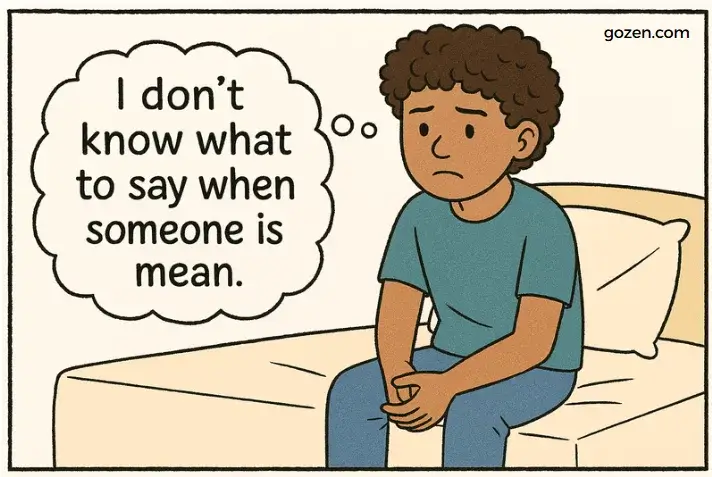
Your child comes home from school and says nothing. But later, while brushing their teeth or curling up at bedtime, it tumbles out: “Someone took my pencil and wouldn’t give it back… and everyone laughed.”
You pause, heart aching. “What did you say?” you ask.
They just shrug. “Nothing.”
For many kids, standing up for themselves feels impossible. They might worry about being rude, getting in trouble, or losing friends. Even when they know something doesn’t feel right, they freeze—or fawn—because they don’t have the tools, the words, or the confidence.
Teaching kids to stand up for themselves isn’t just about handling conflict. It’s about nurturing assertiveness, emotional safety, and healthy boundaries—skills that predict stronger self-esteem, better peer relationships, and even improved academic outcomes. In fact, research shows that assertive children tend to experience lower levels of anxiety and depression because they’re more likely to advocate for their needs and express emotions constructively (Prakash et al., 2013).
Most kids don’t become assertive just because we tell them to “speak up.” They need to hear examples, practice phrases, and try out scripts in low-stakes moments before they can use them under pressure.
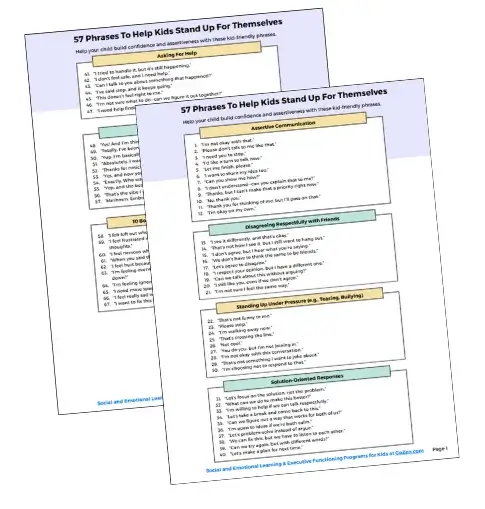
We’ll break down the essentials of assertive communication, show you how to coach your child through tough moments, and offer a free printable of 57 kid-friendly phrases that empower them to find their voice. Because standing up for yourself is a skill, and like all skills, it gets easier with the right support and tools.
Grab your free printable here:
Included in this Article:
- Why Kids Struggle to Speak Up
- Assertive vs. Aggressive Communication
- Disagreeing Respectfully with Friends
- Standing Up Under Pressure
- When to Involve Adults or Authority Figures
- Practice Makes Progress
- Grab Your Printable
Why Kids Struggle to Speak Up
Even when a kid knows something’s not right—someone crosses a line, makes a joke at their expense, pressures them to go along—they often say… nothing.
It’s not that they don’t care. It’s that speaking up in the moment feels risky. What if they sound rude? What if they make things worse? Many kids would rather blend in than risk rocking the boat.
Biologically, it makes sense. When stress kicks in, the brain’s protective system can override thoughtful decision-making. Instead of speaking clearly, many kids freeze or “fawn”—going along just to avoid confrontation. Without tools, those moments of discomfort pile up, and kids learn to stay quiet.
There’s also the mixed messaging they’ve heard: “Be respectful.” “Be nice.” “Don’t talk back.” These aren’t bad values, but without context, they can leave kids confused about how to advocate for themselves without seeming “mean” or disrespectful.
Research shows that kids who learn to communicate assertively tend to have stronger friendships, higher self-esteem, and fewer internalizing struggles like anxiety and depression (Spence, 2003; Prakash et al., 2013). But assertiveness isn’t something most kids just know how to do. It’s a skill. And like any skill, it requires practice.
Assertive vs. Aggressive Communication
Assertiveness is not a loud or forceful response, but a clear and respectful way to speak up. Before kids can practice it, though, they need to understand what it actually looks like—and how it’s different from being aggressive.
Assertive communication means expressing your thoughts, needs, or boundaries clearly and respectfully. Aggressive communication, on the other hand, often involves blaming, shouting, or controlling others, and it usually shuts down the connection rather than builds it.
Learning this difference is crucial for kids navigating friendships, group work, and growing independence. Many are afraid that speaking up will make them seem bossy or mean, especially if they’ve only seen adults model aggressive communication under stress.
So what does assertiveness look like in action?
Compare:
- Aggressive: “You always cut me off—stop being so rude!”
- Assertive: “I’d like a turn to talk now.”
Here are a few phrases from the printable that help kids stay in that assertive zone:
- “Let’s take a break and come back to this.”
- “Please don’t talk to me like that.”
- “I respect your opinion, but I have a different one.”
- Can we listen to each other without interrupting?
Practicing these phrases aloud helps kids build fluency and emotional regulation. The more they understand what assertiveness looks and sounds like, the more confidently they’ll use it.
Disagreeing Respectfully with Friends
Friendships are incredibly important during the tween and middle school years, but that doesn’t mean kids have to agree on everything. In fact, learning to disagree respectfully with friends is a powerful way to build trust, set boundaries, and stay true to oneself.
The challenge? Many kids fear that disagreement will cause drama, hurt someone’s feelings, or even end friendships. They might nod along when they don’t agree or go along with something just to avoid conflict.
But a real connection can handle respectful disagreement. It starts with tone and intent—not trying to win an argument, but expressing your viewpoint in a calm way.
Some helpful phrases from the printable include:
- “I see it differently, and that’s okay.”
- “That’s not how I see it, but I still want to hang out.”
- “I don’t agree, but I hear what you’re saying.”
These phrases communicate difference without distance. They let friends know: we don’t have to match to matter. When kids see disagreement as part of a healthy connection—not a threat to it—they become more secure in both their friendships and themselves.
Standing Up Under Pressure: Handling Teasing, Bullies, or Peer Influence
When kids are put on the spot—teased, challenged, or pressured—they often freeze or go along, even if it makes them uncomfortable. That’s not weakness; it’s biology. The brain’s threat system activates, making clear thinking and speaking up much harder.
That’s why it helps to rehearse strategies in advance—including one that can be surprisingly effective: the improv-inspired “Yes, and…” response.
This technique disarms teasing with a twist of humor. For example, if someone says, “Nice shoes—did you get them from the trash?” a clever comeback might be: “Yes! And they came with a banana peel hat too. It’s the latest trend.”
You’ll find more of those phrases in the printable. This kind of playful confidence can take the wind out of a bully’s sails. It won’t work for every kid or moment, but it’s a powerful tool for those who enjoy humor.
Other go-to responses include:
- “That’s not funny to me.”
- “I’m walking away now.”
When to Involve Adults or Authority Figures
Learning to stand up is powerful, but knowing when to ask for help is equally important. Research shows that bullying often continues when adults aren’t aware or don’t respond promptly. That’s why it’s crucial to teach kids that reporting isn’t telling on someone—it’s a smart, courageous act.
Signs it’s time to involve an adult
- The behavior is ongoing or escalating.
- There’s physical danger, emotional harm, or threats.
- The situation can’t be resolved alone, even with assertive or solution-focused efforts.
Kids often try to solve things themselves first, and when they can’t, giving them a script and permission to speak up makes a huge difference.
What kids can say when they need support:
- “I tried to handle it, but it’s still happening.”
- “I don’t feel safe, and I need help.”
- “Can I talk to you about something that’s going on?”
These phrases validate the child’s attempts at assertiveness while shifting responsibility to adults who can intervene.
Coaching your child—what to say at home
- “It’s brave to ask for help. You didn’t fail—you found a smart way forward.”
- “Telling someone isn’t tattling—it’s problem-solving.”
- “Let’s figure out the next step together—whether it’s talking to a teacher or planning a safe exit.”
Practice Makes Progress
Like any life skill, standing up for yourself gets easier with practice. But here’s the key: kids need safe, low-stakes opportunities to try these phrases on for size before they ever use them in the wild.
One of the best ways to build these muscles is through role-playing. After a tough social situation or even during a car ride, take a moment to say, “Let’s pretend I’m the kid who said that thing—and you try out one of your power phrases.” The goal isn’t to “get it right” the first time. It’s to experiment. To find what feels natural. To laugh a little. The sillier and more playful it is, the more likely kids are to join in.
You can also make it a game—switch roles, try it in a robot voice, or even add silly props. Practicing scripts in a low-pressure way helps kids rehearse what they might say later when the stakes are higher.
Another great tool? Books, movies, or shows. Kids are constantly absorbing social dynamics from media. When a character is teased, excluded, or pressured, pause and ask: “What could they have said?” or “What would you do in that situation?” This helps kids build awareness about what they could say, but when and how to say it.
Finally, remember: even just thinking about what they wish they’d said is a win. Those post-game reflections are mini rehearsals. When your kiddo says, “Next time, I think I’d say…” you know the skill is sinking in.
Most importantly, celebrate effort, not perfection. Acknowledge moments of courage with simple affirmations like “That took guts” or “You used your voice—I’m proud of you.” Every attempt is a step toward self-confidence that lasts.
Grab The Printable!
Want a cheat sheet to practice with your child? Download your free printable with 57 phrases to help kids stand up for themselves. Use it as a fridge reminder, a lunchbox note, or a bedtime conversation starter. These phrases are just the beginning of a lifelong skill set.
Article References:
Pourmohamadreza‐Tajrishi, M., Mohagheghi, M., Shahshahanipour, S., Movallali, G., & Vahedi, M. (2022). The effectiveness of assertiveness training on anxiety symptoms in school-age children with specific learning disorder. Iranian Journal of Pediatric Neurorehabilitation, 9(1), 31–36.
Prakash, S. (2013). Assertiveness among adolescent students: Relationship with social skills and personality development. International Journal of Advanced Scientific Research, 4(2), 50–55.
Spence, S. H. (2003). Social skills training with children and young people: Theory, evidence, and practice. Child and Adolescent Mental Health, 8(2), 84–96.
It’s wounderfull, not just for kids, for adults also!