TL;DR:
This blog offers positive, empathetic phrases parents can use to help children manage anger constructively. Instead of dismissing or punishing emotions, these alternatives promote connection, validate feelings, model emotional regulation, and redirect behavior through communication, playfulness, and collaboration.
- Replace harsh commands with curious, reflective language
- Validate emotions instead of minimizing them
- Use playful techniques like “warrior cry” or “blowing candles”
- Shift time-outs into supportive time-ins
- Encourage teamwork and problem-solving
- Model emotional control through your own reactions
- Offer choices to regain a child’s sense of control
- Turn meltdowns into moments of connection
Whether your child has a slow burning fuse or explodes like a firecracker, anger coping skills for kids can help. While we can’t make an angry child happy, we can offer tools for them to handle their feelings.
As parents, we lay the foundation for this skill set by governing our own emotions in the face an angry outburst. Sometimes, helping a child with anger issues is as simple as turning the mood silly. Next time you are dealing with a tantrum, an angry child, or a cold teenager, try one of these anger management phrases:
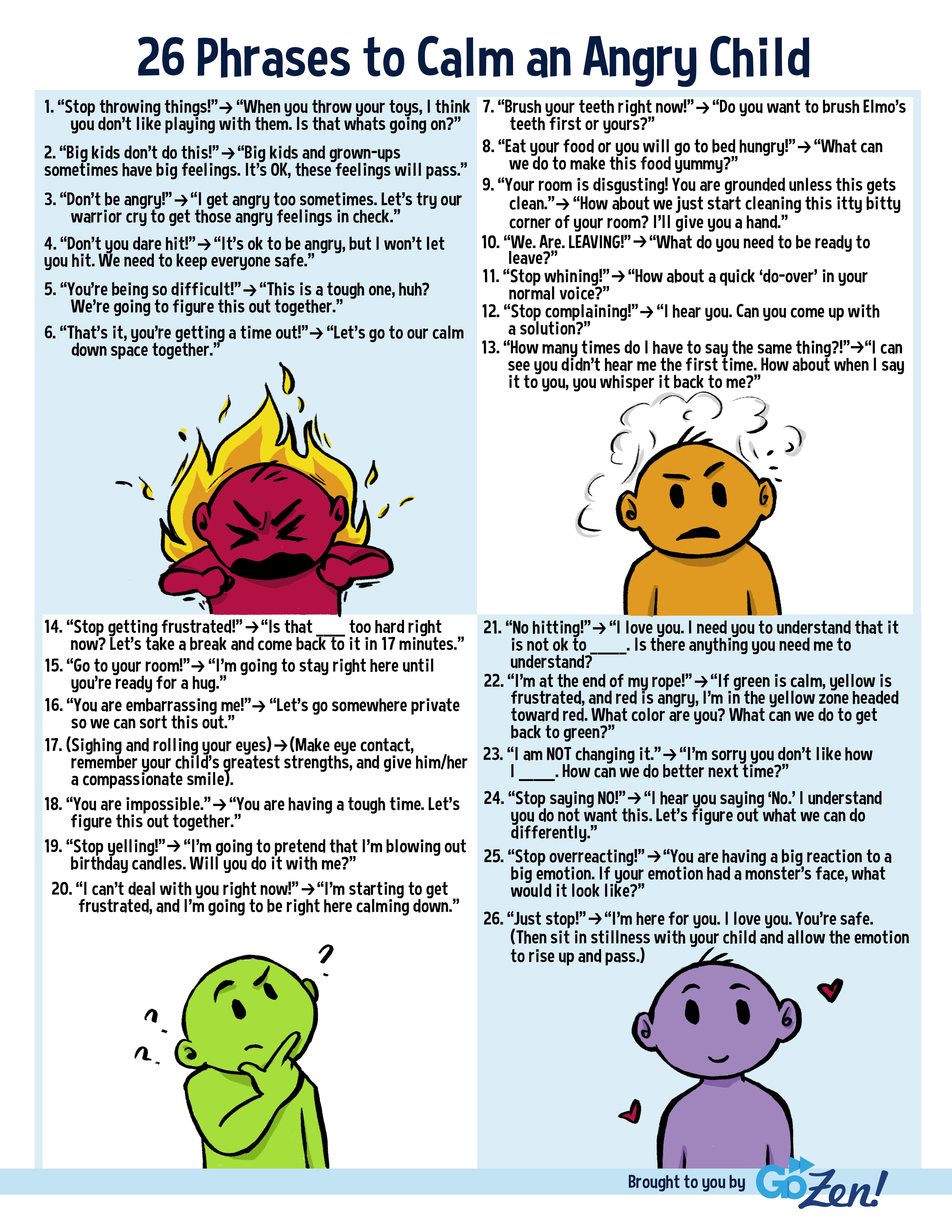
- Instead of: Stop throwing things!
Try this: When you throw your toys, I think you don’t like playing with them. Is that what’s going on?
Model safe communication in which you’ll listen, and they can express themself.
- Instead of: Big kids don’t do this!
Try this: Big kids and even grownups sometimes have big feelings. It’s OK, these feelings will pass.
Don’t encourage them to avoid their emotions, but to process in a healthy way.
- Instead of: Don’t be angry!
Try this: I get angry too sometimes. Let’s try our warrior cry to get those angry feelings in check.
A recent study reveals that yelling when we are physically hurt can prevent pain messages from reaching the brain.
- Instead of: Don’t you dare hit!
Try this: It’s OK to be angry, but I won’t let you hit. We need to keep everyone safe.
This gets the message firmly across that the emotion is okay, but the action is not.
- Instead of: You’re being so difficult!
Try this: This is a tough one, huh? We’re going to figure this out together.
When children are digging in their heels, it is important to understand why and to get back on the same page.
- Instead of: That’s it, you’re getting a time out!
Try this: Let’s go to our calm down space together.
This flips the script of “time out” to “time in,” allowing for reconnection instead of isolation.
- Instead of: Brush your teeth right now!
Try this: Do you want to brush Elmo’s teeth first or yours?
For toddlers, tantrums are a way to exert control over their environment. This way, you are offering your toddler a choice, and in turn, some control.
- Instead of: Eat your food or you will go to bed hungry!
Try this: What can we do to make this food yummy?
This places the responsibility of finding a solution back on your child.
- Instead of: Your room is disgusting! You are grounded unless this gets clean.
Try this: How about we just start cleaning this itty bitty corner of your room? I’ll give you a hand.
Breaking tasks into manageable segments and shifting the goal to just beginning can reframe a confrontation.
- Instead of: We. Are. LEAVING!
Try this: What do you need to do to be ready to leave?
This helps avoid a power struggle and allows them to recognize that they’re transitioning to a new activity.
- Instead of: Stop whining!
Try this: How about a quick “do over” in your normal voice?
By asking them to rephrase in a normal tone, you are teaching them that the way they say things matters.
- Instead of: Stop complaining!
Try this: I hear you. Can you come up with a solution?
Again, this places the responsibility back on the child—encourage silliness!
- Instead of: How many times do I have to say the same thing???
Try this: I can see you didn’t hear me the first time. How about when I say it to you, you whisper it back to me?
Having children repeat what they hear will solidify your message, and varying the volume makes it fun.
- Instead of: Stop getting frustrated!
Try this: Is that ___ too hard right now? Let’s take a break and come back to it in 17 minutes.
It sounds random, but a research-based formula for productivity is to work for 52 minutes, break for 17.
- Instead of: Go to your room!
Try this: I’m going to stay right here by you until you’re ready for a hug.
Again, isolation sends the message that there is something wrong with your child.
- Instead of: You are embarrassing me!
Try this: Let’s go somewhere private so we can sort this out.
Remember, it’s not about you. It’s about your child and their feelings. Reinforce the team effort without drawing attention to their behavior.
- Instead of: (Sighing and rolling your eyes)
Try this: (Make eye contact, remember your child’s greatest strengths, and give her a compassionate smile.)
Practice keeping it in perspective by seeing the strengths in your child.
- Instead of: You are impossible!
Try this: You are having a tough time. Let’s figure this out together.
Always separate the behavior from the child, validate their feelings, and work together for solutions.
- Instead of: Stop yelling!
Try this: I’m going to pretend I’m blowing out birthday candles. Will you do it with me?
Deep breathing helps restore the body to a calm state, while being playful speeds cooperation.
- Instead of: I can’t deal with you right now!
Try this: I’m starting to get frustrated, and I’m going to be right here calming down.
Teach children how to label and govern their emotions by modeling this in real time.
- Instead of: No hitting!
Try this: I love you. I need you to understand that it is not okay to ____. Is there anything you need me to understand?
This keeps the lines of communication open while expressing the emotion in a healthy way.
- Instead of: I am at the end of my rope!
Try this: If green is calm, yellow is frustrated, and red is angry, I’m in the yellow zone headed toward red. What color are you? What can we do to get back to green?
Give children a visual to express how they are feeling. Work together to make things better.
- Instead of: I am NOT changing it!
Try this: I’m sorry you don’t like how I ___. How can we do better next time?
Shifting the focus from the event to the solution eliminates a power struggle.
- Instead of: Stop saying “No!”
Try this: I hear you saying “No.” I understand you do not want this. Let’s figure out what we can do differently.
By acknowledging your child’s “No,” you are de-escalating the situation.
- Instead of: Stop overreacting!
Try this: You are having a big reaction to a big emotion. If your emotion had a monster’s face, what would it look like?
When kids are tired, hungry, or overstimulated, they are going to overreact. Putting a face to the emotion externalizes the issue and allows children to take control over their anger.
- Instead of: Just stop!
Try this: I’m here for you. I love you. You’re safe. (Then, sit in stillness with your child).
Anger and panic are often symptoms of a stress response. These emotions may signify that your child feels literally unsafe. Letting them know they are safe supports them until the discomfort passes.
Thank you!!!
How does that help the child develop internal restraints? You can’t always be there to stop him. He has to learn to control himself. I say “no when the child wants to do something wrong, but I don’t leave him hanging with no way out of the strong emotions. He’ll have to swallow the emotions and will only learn to do that, which doesn’t turn out well. Put more effort into the most important job you’ll ever have.
Helps to explain why. They’re *people* learning to deal with emotions and actions.
Yikes! I believe we should just be kind, especially to our own children. For every one time you say no, don’t, or stop to your child/class/student, you should follow it with at least 5 positive, descriptive statements of feedback or encouragement. It’s evidence based- try it out
Thanks
Your children will be who they are when they grow up depending on how you treat them. You’re the potter, they’re the clay.
Children are human beings, who experience hard times just like we do. If you practice the intense self discipline to be successful with the examples provided in this article, you’ll be rewarded with amazing relationships with your kids when they’re adults.
Brilliant.
Thank you for this! Totally helpful to have options and tools to help our children through big feelings.
Idk about anyone else but as a kid these used to make me angrier
Its not all this or all that. I think some of these are too wordy for concrete minds BUT there are some that lessen the power struggle that is at the root of most conflicts. Choose and use! What’s wrong with more tools in your toolbox?
I appreciate these examples. I love them and wish I heard them more myself growing up. I’m already using some similar in the Childcare environment, and now have a few more. Thank you!
Who likes to hear “no, stop, quit, etc. all day, I know it would frustrate me as an adult! This is a great resource to put a positive spin on things and to help kids effectively work through their emotions while helping the adult remain calm!! Why join in on those big emotions, instead be the calm in the storm!
Gracias
Thank you for this article. I think that some people will have a hard time understanding this because it is out of the norm and the way that most of us were raised. You know, “a child is to be seen and not heard”, “do as I say and not as I do”, “I am the Adult I know better, because I’ve already been were you are”. All of these to me is hypocritical and I think that we as parents and as the adults must set the tone and be the appropriate role model for our children. I believe that they learn more from the unspoken, from what they see us do than what we we tell them or preach to them. I think that it will take us as the adults to really dig deep within ourselves and find that place of understanding for us to start to make some of these changes. I know when I first hear some of these things years ago, I was like what is the foolishness, but once I put self aside and actually tried it with my children, I saw the benefits of stepping outside of my comfort zone. So again thank you for this!!!
I just read an article describing what you’re saying, it’s called humility, which is where we are teachable. This turns our thinking from inward to outward, stopping the trend of self-centered or me mind-set. I enjoyed your post.
I love this! Thank you.
These are excellent suggestions! They teach children strategies to calm themselves and to overcome frustrations in appropriate ways.
Some adults could benefit from this also
well maybe plain kind
true
These phrases are very helpful. In line with trying to be a less reactive parent. Thank you for the inspiration!
I so appreciate this. As others have said, it is helpful to have these tools, to have relationship-centered parenting with kindness and in love.
Thank you they are useful phrases!
These are awesome, useful phrases. My family have used some of these already with my granddaughter. Thank you for these great phrases!